The Milei administration is running a curious (to say the least) bit of accounting and financial engineering to dress up the national accounts. But it doesn’t actually matter, and I think it’s a smart exit to the ticking time bomb they inherited.
A bit of context
A cornerstone of Milei's stabilization plan was the unwinding of the central bank's massive interest-bearing liabilities. In addition to the 3-4pp fiscal adjustment, part of the correction of state finances was the elimination of the quasi-fiscal deficit generated by the central bank. The BCRA, which itself issued pesos to finance the fiscal deficit directly, then re-absorbed those pesos by selling 'letras' to banks. To motivate banks to buy these bills, the BCRA offered yields exceeding deposit rates (and inflation rates), which required yet more peso issuance to cover. This quickly compounded and had created an enormous liability on the BCRA's balance sheet with immediate rollover risk. At the peak, interest bearing liabilities were almost three times the monetary base, interest paid on them by the central bank was 10% of GDP annualized. This sounds so incredibly stupid but sadly it is factual.
The plan to dismantle this problem consisted of first guiding the monetary policy interest rate down to deep negative real territory, thereby endogenously reducing money creation for interest payments. And then to (i) sterilize all remaining interest-bearing liabilities, (ii) end Treasury financing via the central bank. Bank holdings of BCRA liabilities were exchanged for a new overnight treasury bill, the 'Letra Fiscal de Liquidez' (LEFI). By moving the debt from the central bank's balance sheet to the governments balance sheet, the interest burden shifted to the fiscal accounts where it can be serviced with genuine budget resources. The swap was done at market terms, without defaulting on contracts and the banks voluntarily rolled into the new instruments.
But the sensible question to ask is: if the BCRA couldn’t pay for all this interest, how will the Treasury?
LECAPs: Capitalizable Bonds
As part of the reform of the central banks transmission instruments, and the plan to “hide” these interest payments, these LEFI instruments were entirely rolled into LECAPs.
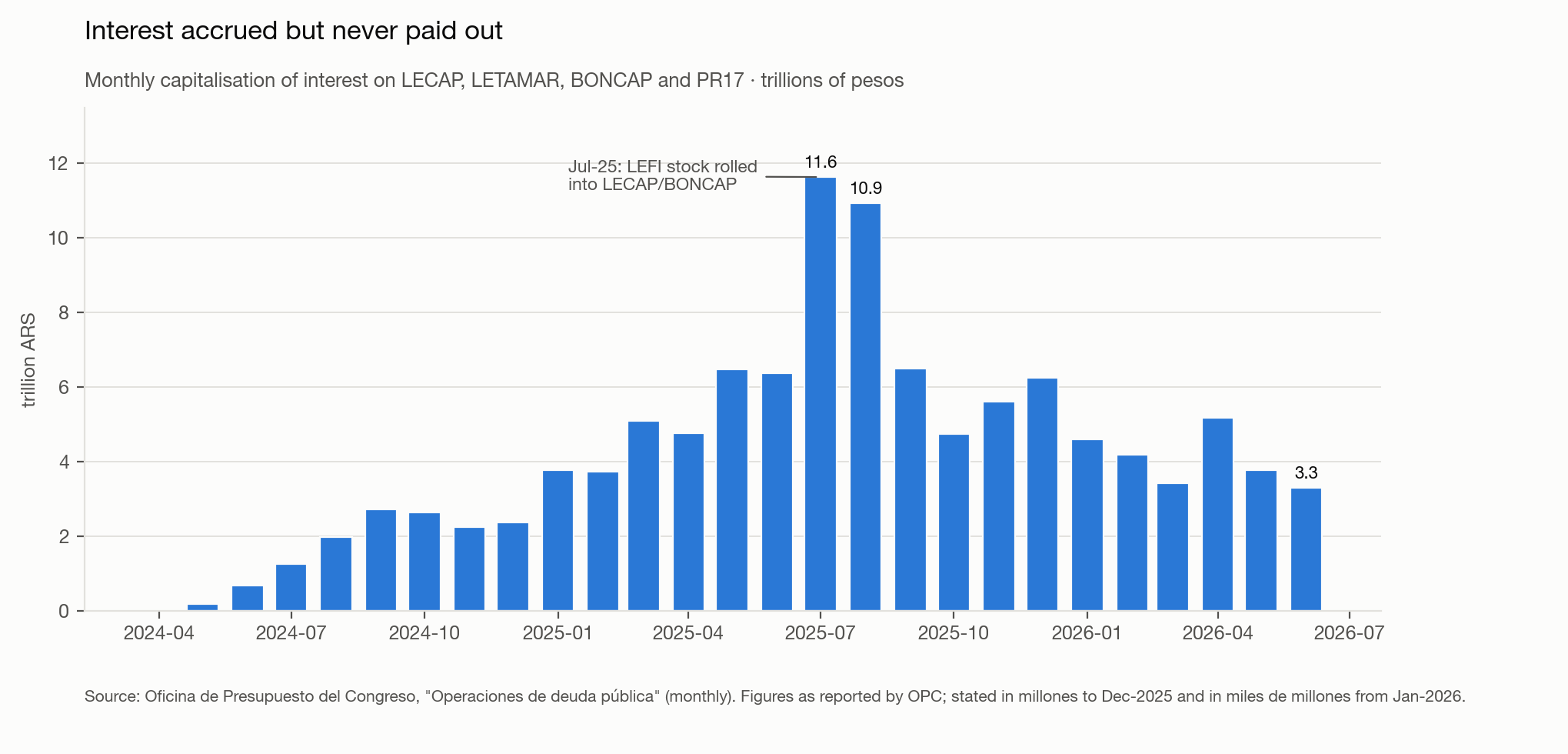
What is a LECAP, specifically? LECAPs are capitalizable bonds ('LEtras CAPitalizables'), meaning bonds whose interest is added to the loan balance: “capitalized.” The issuer does not pay cash coupons periodically, instead the interest is added to the bond principal and is paid at maturity.
This is where the administration is hiding the interest of the past central bank’s debt.
Cash vs Accrual reporting
What about the fiscal “surplus”? The following is a quote from a footnote of the IMF's July 2025 'First Review Under the Extended Arrangement' Report: “[Deficit] Calculated based on the authorities' reported cash interest payments, which exclude capitalized interest payments recorded below the line.” That capitalized interest is recorded “below the line”, as a stock change rather than as an expense.
The international accounting standard for the government's headline deficit/surplus calculation is to use the accrual method; interest expense should be recorded as it accrues even if no interest is actually paid out.
The Argentine administration never reports an accrual number at all, they don’t even refer to it or make explicit that the budgetary result is on a cash basis. This is why I claim it’s misleading to say the least.
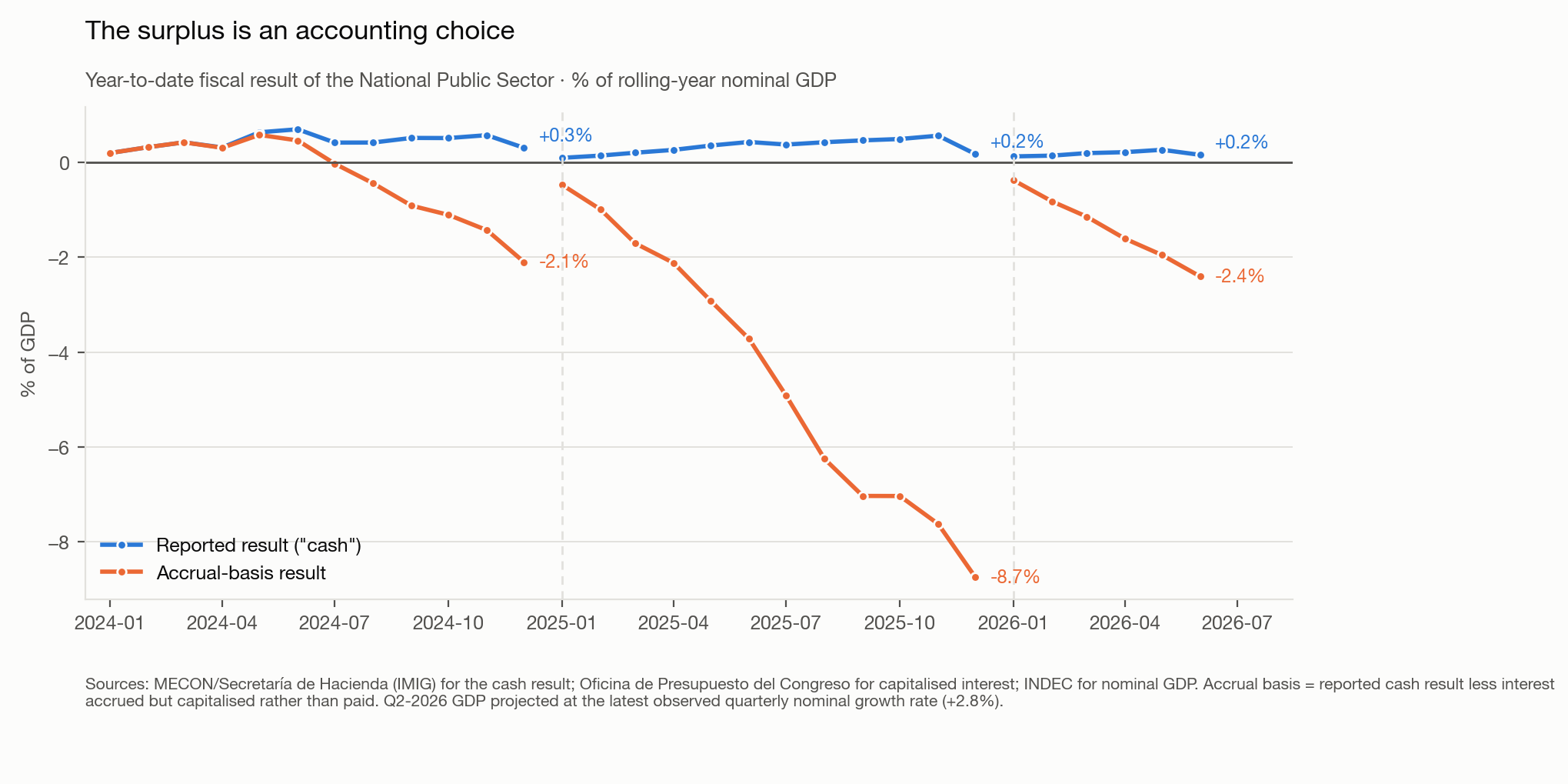
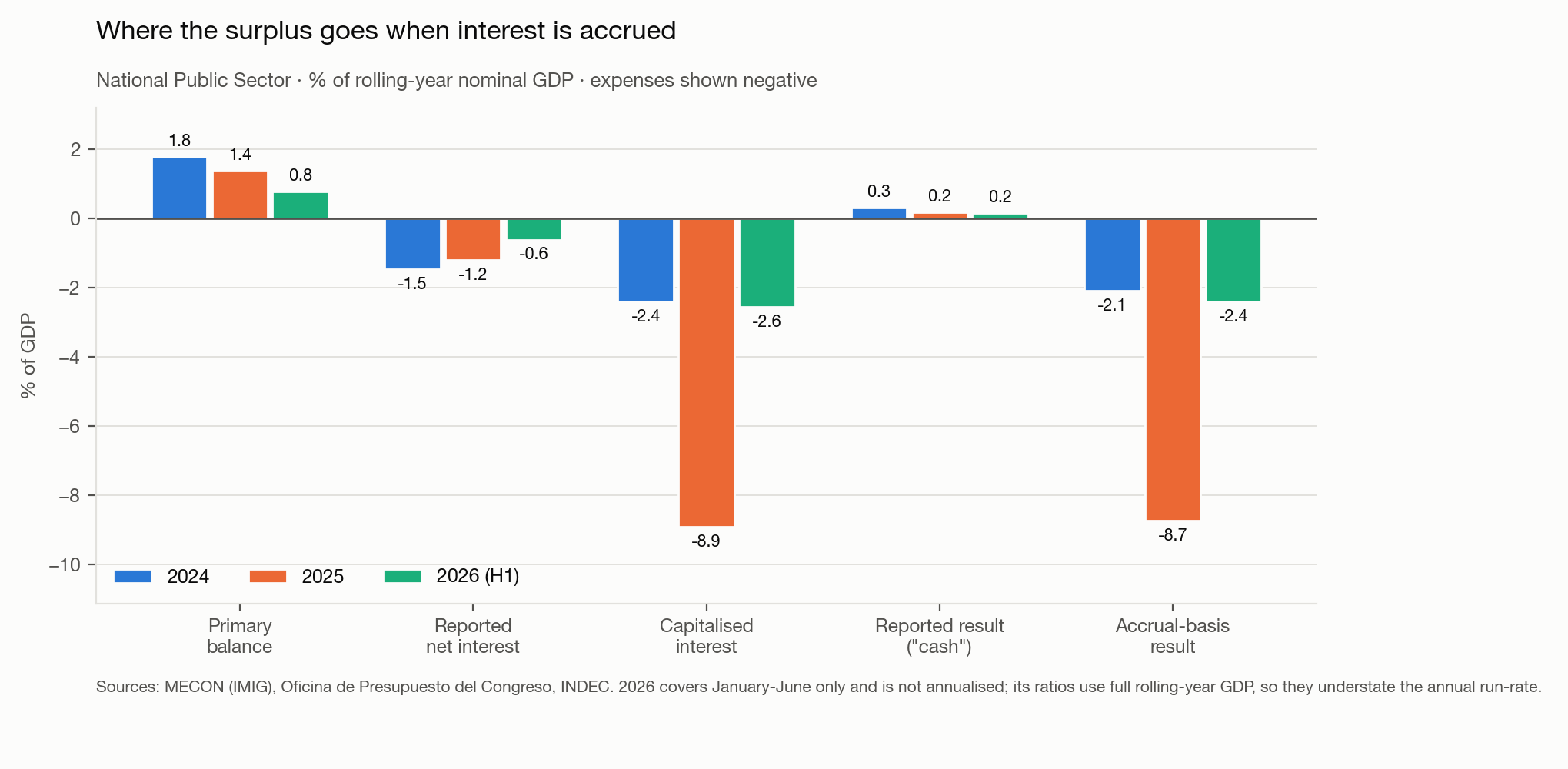
The administration is using LECAPs to defer the interest payments. The Treasury can, in principle, roll principal plus capitalized interests at maturity without any immediate negative cashflow.
That said, Argentina's binding problem is cash-flows, not an unsustainable debt stock. With absolutely no access to international capital markets, the government could not withstand even a small negative cash flow. In fact previous crises were cause by relatively small deficits. These are peso liabilities, and while the interest rate is nominally high, it is also true that inflation is 32% YoY. If it helps the government regularize cash flows and avoids printing pesos, it might be reasonable choice to report deficits on a cash basis.
What it did to the debt stock
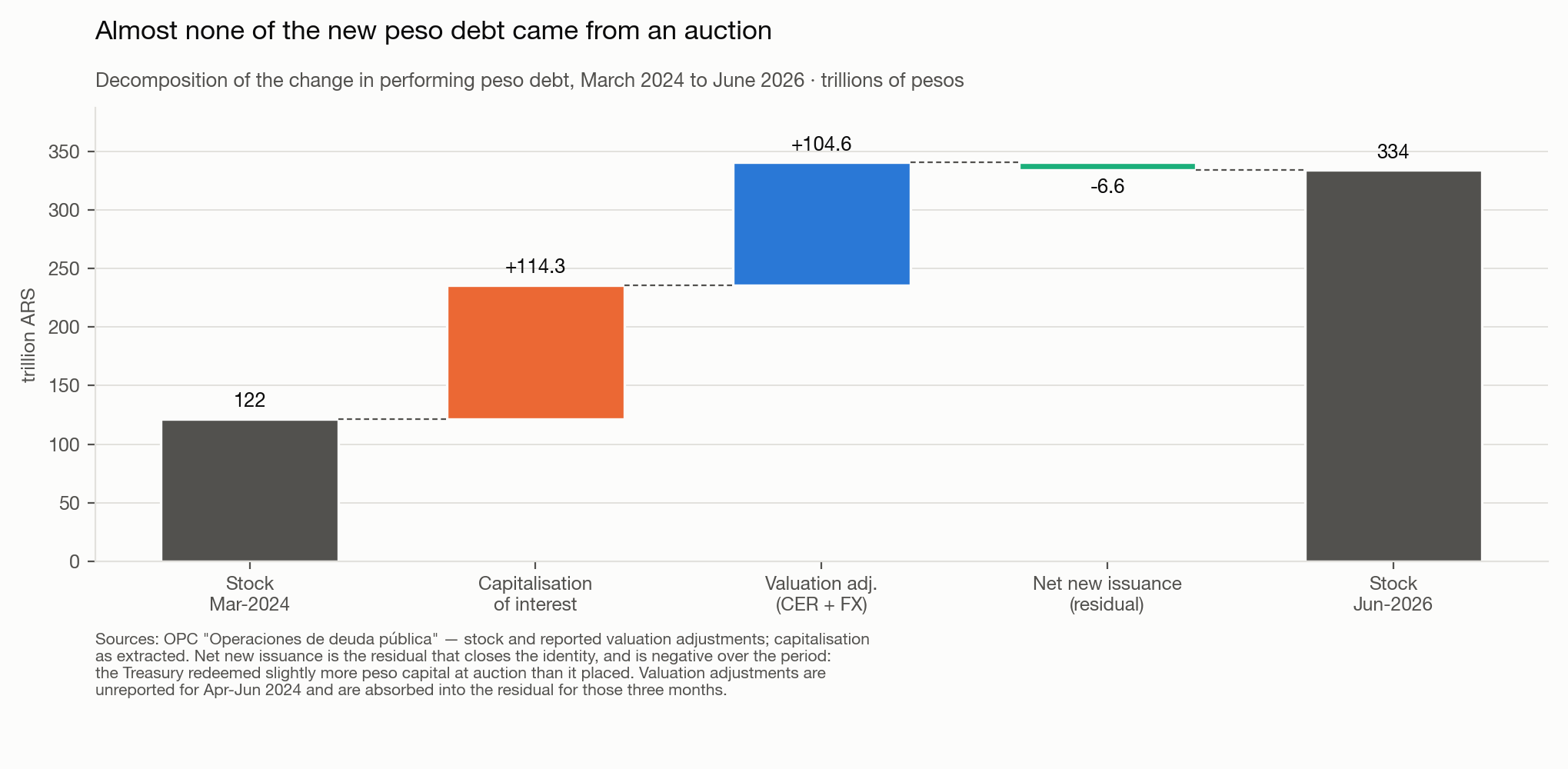
Performing peso debt rose from 121.7tn pesos in March 2024 to 333.9tn in June 2026. Decomposing that increase using the OPC's own reconciliation, capitalised interest accounts for 53.8% of it and CER/FX indexation for most of the rest. Net new issuance at auction over the whole period was slightly negative — the Treasury placed less peso capital than it redeemed.
Conclusion
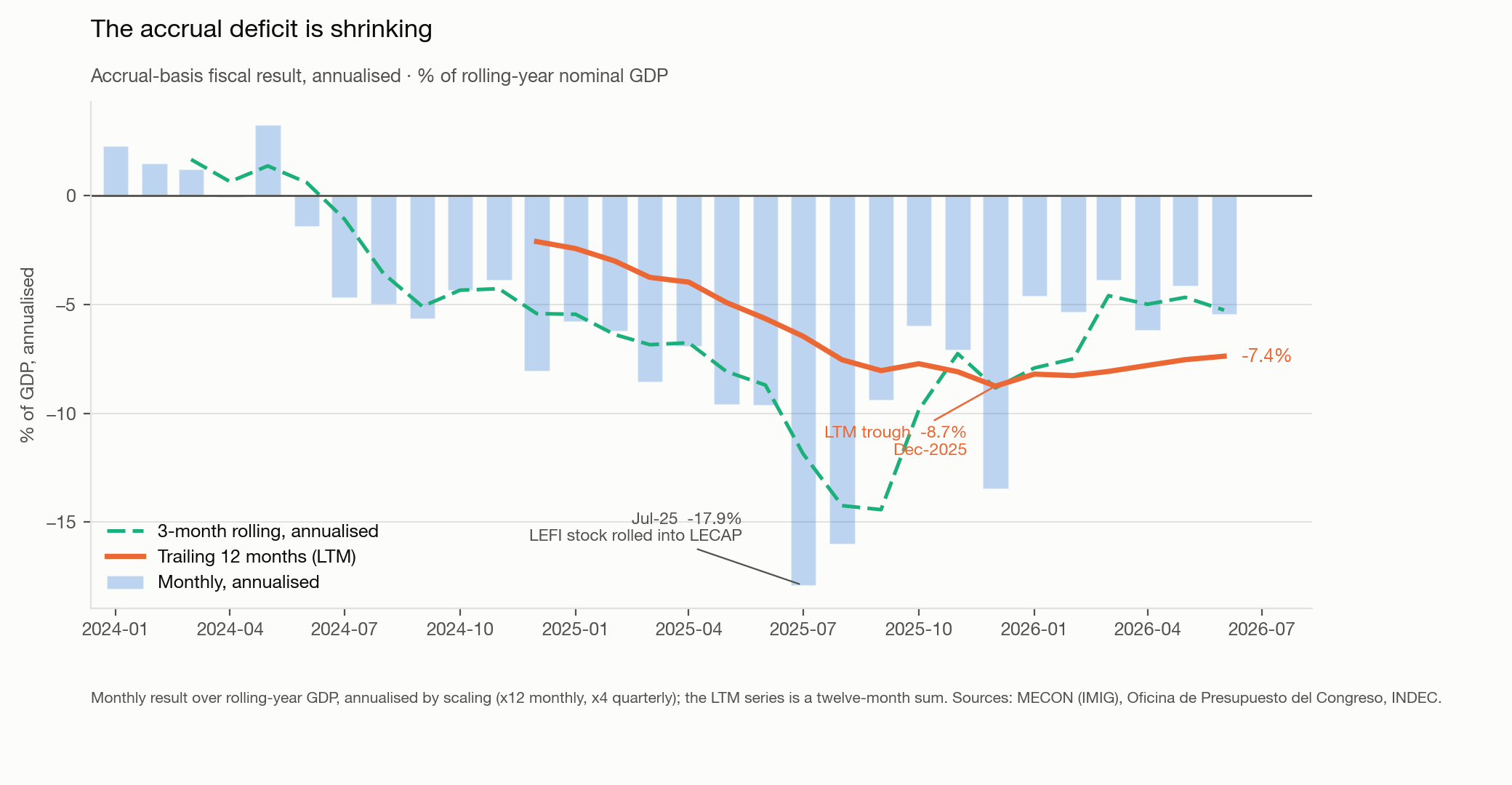
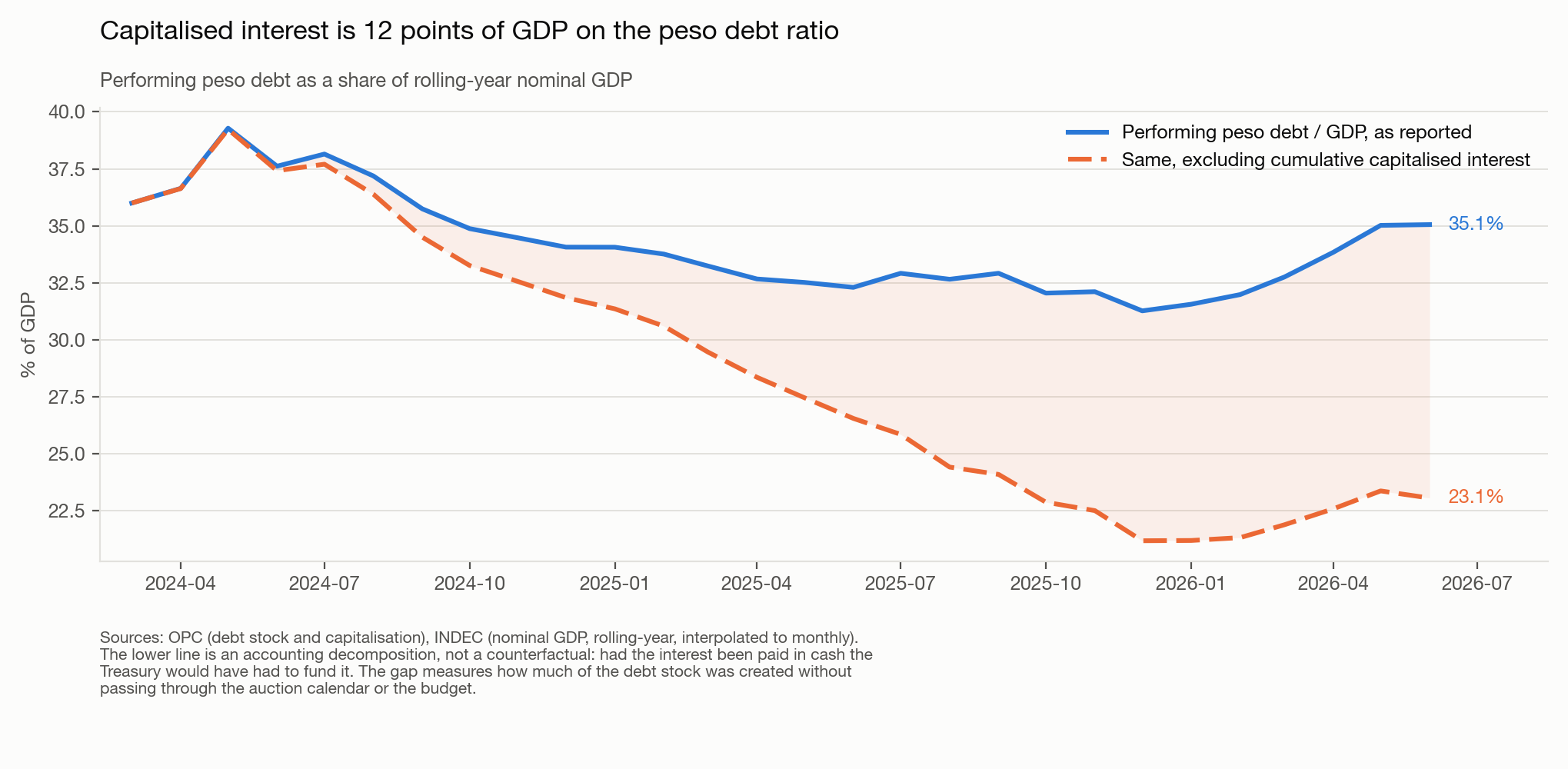
The scary -8.7% accrual deficit figure is a nominal figure on peso-denominated, unindexed debt. Most of that accretion is a balance between the principal being eroded and the compensation of inflation. A real burden would be an excess of TEM over inflation, which since December has mostly been negative. Peso debt is in fact lower now in relation to GDP than in 2024. If the accrual deficit were really 8.7% of GDP in a real sense, the ratio would be exploding, and it isn't
While the rate set at auction has been below inflation since the beginning of the year, the average rate on outstanding stock is still mildly positive in real terms because it holds paper issued in 2025 at much higher rates and hasn't yet matured. Capitalisation is equal to stock x rate and the implied rate halved from 5.0% to 2.5%. Nominal capitalisation fell 47%, and nominal GDP grew 12% over the last six months. The capitalising stock grew 6.8% in nominal terms and shrank 8.5% in real terms.
Peso debt to GDP has now been climbing slightly since January, from 31.6% to 35.1%. The accrual deficit affects the capitalising leg, but the change in this ratio is now driven by the CER-indexed leg. This indexation is revaluing the principal with lagged inflation and (lagged) inflation is now slightly outrunning nominal GDP growth. The capitalising leg continues to deflate but the indexation problem is taking place so long as inflation remains stubborn at around 30%.
In some sense it totally makes sense to report Argentina's deficit as a cash measure, especially because Argentina's fiscal problem is not (and has never been) a stock issue but a cash flow issue, and this solves that neatly.
Sources, and where the number is hidden
The accrual figure is not published anywhere. The OPC states in each monthly execution report that "los registros de E.Sidif y Presupuesto Abierto no incluyen intereses de títulos públicos capitalizables".
Where it does appear is the debt records, the Secretaría de Finanzas' register of public debt operations. It surfaces there only because the monthly change in peso debt capital has to be reconciled, and that identity is
Δ debt = net capital operations + valuation adjustments (CER and FX) + capitalisation of interest
Around page six of the OPC's "Operaciones de deuda pública"
Manually (Claude) had to read that line on each PDF of 28 consecutive monthly reports covering March 2024 to June 2026, and rebuilding the series. Fiscal aggregates, nominal GDP and CPI come from the datos.gob.ar time-series API. The accrual result is then simply the reported cash result less capitalised interest for the same month.
Find details, data, scripts, workbooks on my github: github.com/matibonfanti/argentina-fiscal-accounting